To achieve truly "zero-error transmission" in aluminum alloy synchronous pulleys under high-speed CNC machine tool operation conditions, the core lies in the systematic control of tooth profile precision. This involves not only improving individual machining processes but also relying on the coordinated optimization of the entire design, manufacturing, and assembly process.1. Tooth Profile Design and Standard MatchingThe tooth profile of the synchronous pulley must be highly matched with the tooth profile of the synchronous belt, such as standard tooth profiles like HTD and GT. During the design phase, by accurately establishing a mathematical model of the tooth profile, ensuring the continuity and smoothness of the addendum circle, dedendum circle, and involute transition region, meshing interference can be reduced. Simultaneously, for high-speed operating conditions, appropriate micro-modification of the tooth profile can be performed, such as slight edge trimming of the tooth tip, to reduce meshing impact and reduce transmission errors from the source.
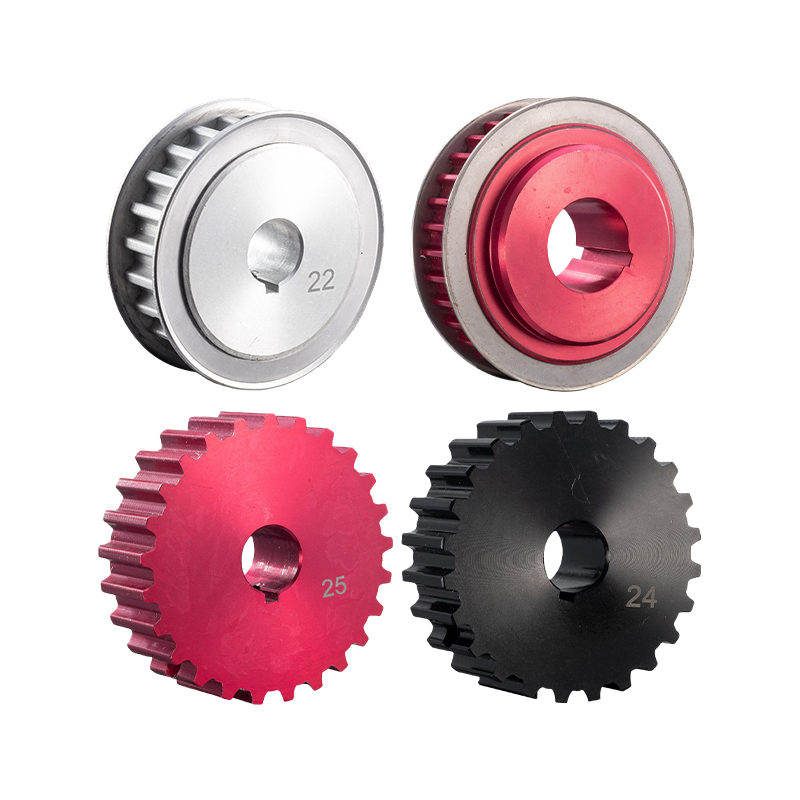
2. High-Precision Tooth Machining TechnologyThe key to achieving high-precision tooth profiles lies in the machining technology. CNC gear hobbing, gear shaping, or precision grinding processes can effectively control tooth pitch and profile errors. In high-end applications, grinding is often used to further improve surface precision, achieving micron-level surface roughness, thereby improving meshing smoothness. Furthermore, strict control of tool wear and machine tool thermal deformation is required during machining, using online detection and compensation technologies to ensure consistency in each tooth profile.3. Material Properties and Heat Treatment ControlAlthough the main body is made of aluminum alloy, synchronous pulleys often need to balance lightweight and strength requirements. Therefore, steel components may be incorporated or surface strengthening treatments may be applied to critical load-bearing areas. Anodizing and nickel plating processes not only improve wear resistance but also reduce the accumulation of errors caused by microscopic wear on the tooth surface. Simultaneously, heat treatment deformation must be strictly controlled to avoid tooth profile deviations due to residual stress, which would affect transmission accuracy.4. Assembly Accuracy and Dynamic BalanceUnder high-speed operating conditions, even with high tooth profile machining accuracy, assembly errors can introduce new deviations. Therefore, during installation, the coaxiality and radial runout between the synchronous pulley and the shaft must be controlled within a minimal range. Simultaneously, dynamic balancing eliminates centrifugal imbalance forces during high-speed rotation, preventing vibration from interfering with meshing accuracy and maintaining a stable transmission state.5. System Coordination and Error CompensationTrue "zero-error transmission" relies not only on the pulley itself but also on coordinated optimization with the synchronous belt, tensioning system, and control system. For example, by appropriately setting the preload, the belt teeth and pulley teeth are ensured to always mesh tightly, avoiding hysteresis errors caused by clearance. Furthermore, in high-end CNC systems, software compensation can be used to correct minute periodic errors, achieving a higher level of precision control.
In conclusion, achieving near-zero-error transmission in high-speed CNC machine tool operation requires attention to multiple aspects, including tooth profile design, machining technology, material handling, assembly control, and system coordination. Only through precise control of the entire chain can the ideal error-free transmission state be approximated in practical engineering.