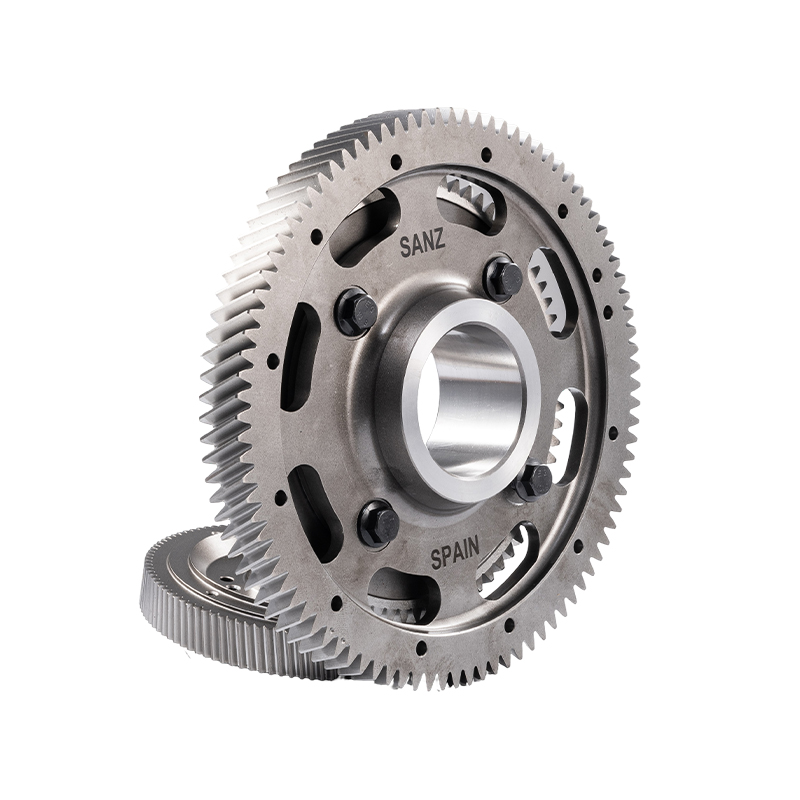
In heavy truck powertrain systems, heavy truck gears bear enormous torque and repeated alternating loads. The tooth root is the area of most significant stress concentration and a high-risk area for gear failure. Optimizing tooth root strength directly affects gear lifespan, transmission reliability, and overall vehicle safety. Especially under high torque conditions, improper tooth root design or insufficient machining quality can easily lead to tooth root fatigue fracture or spalling, resulting in power transmission failure throughout the vehicle.
1. Material Selection and Strengthening Design
Improving tooth root strength primarily depends on the selection of gear materials. Heavy truck gears typically use high-strength alloy steel, which possesses good hardness, toughness, and fatigue strength, enabling it to withstand high torque loads. To further improve tooth root fracture resistance, gear materials usually require heat treatment, such as carburizing and quenching, tempering, or nitriding, to significantly increase surface hardness while maintaining the toughness of the tooth root core, forming a "hard shell, tough core" structure. This combination of material selection and heat treatment effectively enhances the load-bearing capacity of the tooth root under high torque conditions.
2. Optimized Tooth Profile Design for Stress Distribution
The main cause of gear tooth root fracture is stress concentration. Optimizing tooth profile parameters, such as the tooth root fillet radius, pressure angle, and clearance design, can effectively reduce the stress concentration factor at the tooth root. For example, increasing the tooth root fillet radius smooths stress transition, increases the load-bearing area at the tooth root, and thus reduces local stress peaks. Simultaneously, a reasonable pressure angle design improves the gear meshing angle, making the load distribution more uniform and reducing the risk of localized overload at the tooth root. For heavy truck gears bearing high torque, tooth profile optimization is a crucial means of ensuring tooth root strength.
3. High-Precision Gear Machining for Enhanced Strength
Even with reasonable materials and design, insufficient machining precision can affect the tooth root load-bearing capacity. High-precision gear parts, through CNC gear machining, grinding, and precision inspection, allow for strict control of tooth profile, pitch, and height, thereby ensuring smooth meshing and avoiding localized stress concentration. Gear grinding is particularly crucial in this stage. It removes residual stress from rough machining, improves surface finish, and enhances the microstructure of the gear root, slowing the initiation rate of fatigue cracks and significantly improving the tooth root's resistance to fracture under high torque conditions.
4. Surface Strengthening and Residual Stress Control
Under high-load conditions, residual stress on the gear surface and inside the tooth root has a significant impact on fatigue strength. Surface strengthening processes such as carburizing, nitriding, and low-stress grinding can form a compressive stress layer on the tooth root and surface, resisting fatigue cracks caused by tensile stress. Simultaneously, by rationally controlling heat treatment and grinding parameters, internal stress unevenness can be reduced, preventing crack propagation at the tooth root under high torque. These processes effectively extend service life in heavy truck gear manufacturing.
5. Lubrication and Load Distribution Coordination
Gear root strength is not only related to materials and machining but also closely related to lubrication and load distribution during gear meshing. High-quality lubricating oil and a precise lubrication system can reduce local friction and wear at the tooth root, reduce thermal stress, and ensure smooth torque transmission. For multi-stage gearboxes, a reasonable gear combination and meshing sequence can achieve uniform load distribution, reducing the risk of overload on individual tooth roots and thus further improving fracture resistance.
In summary, improving tooth root strength in heavy truck gears under high torque conditions requires the coordinated efforts of multiple aspects, including material selection, tooth profile optimization, high-precision machining, surface strengthening, and lubrication load control. High-precision gear parts and gear grinding technology not only ensure dimensional accuracy and surface quality but also significantly enhance the fracture resistance of the tooth roots.