In the grand narrative of construction machinery, excavators, cranes, and tunnel boring machines are often seen as synonymous with power and roar. However, with increasingly stringent environmental regulations and rising operator comfort requirements, "quiet operation" has become a core competitive advantage for high-end construction machinery. As the heart of power transmission, the noise and vibration control of heavy-duty planetary gearbox gears is particularly crucial. When equipment needs to operate in a low-noise environment, simply improving machining precision is insufficient to cope with the enormous load impact. At this point, the micro-geometric design of the gear teeth becomes the "secret weapon" for achieving dual suppression of vibration and noise. Through precise profile modification techniques, the originally rough mechanical meshing is transformed into a smooth and silent power transmission.
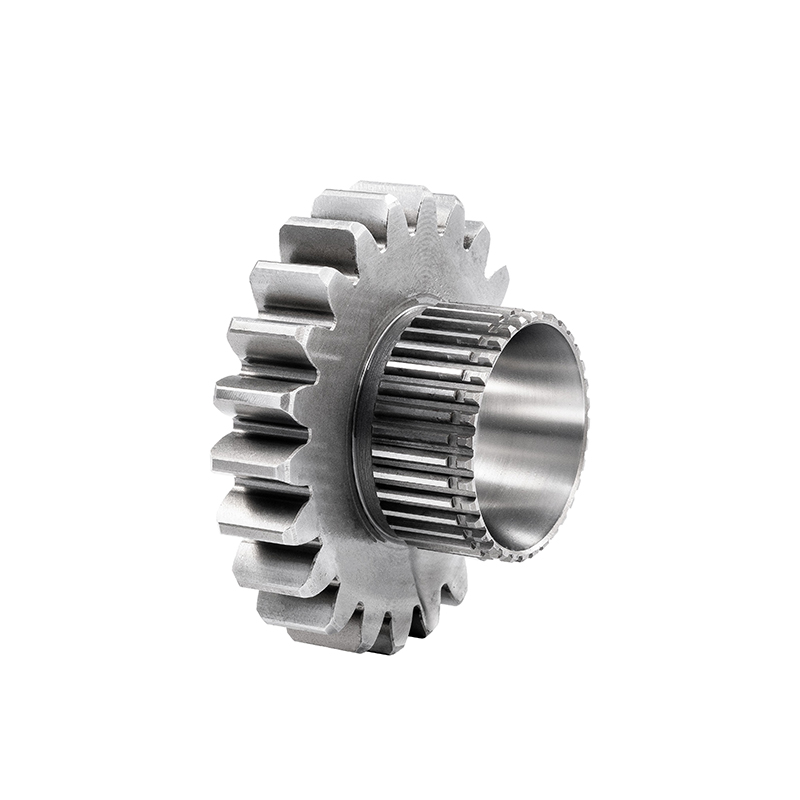
1. From Rigid Impact to Flexible Transition: The Art of Tooth Profile ModificationUnder heavy loads, traditional gears undergo elastic deformation of the teeth, causing the actual meshing point to deviate from the theoretical position, easily resulting in "tooth tip interference" or "tooth root knocking," triggering high-frequency howling and severe vibration. For the unique variable load conditions of construction machinery, heavy-duty planetary gearbox gears employ advanced tooth profile modification technology. Designers perform micron-level micro-removals at the tooth tip and root, creating specific bulges or chamfers.This modification does not weaken strength, but rather compensates for deformation under load. When the gears engage, the modified tooth surface avoids the instantaneous impact of edge contact, allowing the load to rise smoothly from zero, achieving a "soft landing." This flexible transition eliminates abrupt rigid changes during engagement and disengagement, fundamentally cutting off the source of high-frequency vibration noise, ensuring the gearbox maintains a silky-smooth operating rhythm even under hundreds of tons of load.2. The Wisdom of Evenly Distributed Load: Optimization of Tooth Profile Bulk Shape and Helix AngleBesides optimizing the tooth profile direction, controlling the tooth width direction is equally crucial. During operation, construction machinery inevitably experiences slight twisting of the machine body, causing minor misalignment in the gear shaft system. If the tooth surface were an ideal straight line, this skew would cause the load to concentrate at the tooth tip, resulting in severe stress concentration and localized wear, which in turn induces low-frequency noise. Therefore, modern heavy-duty planetary gearbox gears widely employ tooth-direction drum-shaped profiles.By constructing a slightly convex curved surface along the tooth width, after the gear deforms under load, the contact spot automatically expands towards the center of the tooth surface, forming an ideal elliptical contact area. This design ensures that the load is evenly distributed along the tooth width, avoiding vibrations caused by edge effects. Simultaneously, combined with an optimized helix angle design, the meshing overlap of the planetary gear is significantly improved. This means that at any given time, the number of tooth pairs involved in power transmission increases, the load fluctuation on a single tooth decreases, and the transmission process becomes more continuous and smooth. The "overlapping effect" of multiple teeth meshing simultaneously effectively counteracts the pulsation generated by single-tooth meshing, significantly reducing the fundamental frequency amplitude of the noise.3. Synergistic Suppression of Microtexture and Material ResonanceBased on macroscopic tooth profile optimization, surface treatment at the microscopic level also plays a crucial role. Through precise grinding or honing processes, specific micro-textures are formed on the tooth surface. These textures can store trace amounts of lubricating oil, forming a more stable oil film under high-speed, heavy-load conditions. The damping effect of the fluid further absorbs high-frequency vibration energy. Furthermore, the tooth profile design considers the modal characteristics of the gear system. By adjusting the tooth profile parameters, the natural frequency of the gear is altered to avoid common excitation frequencies in engineering machinery engines and hydraulic systems, preventing resonance-induced noise amplification.In summary, heavy-duty planetary gearbox gears, under the requirement of low-noise operation, are no longer simply metal meshing, but a precision system integrating elasticity, tribology, and dynamics. Through tooth profile modification to eliminate impact, tooth-to-tooth drum-shaped uniform load distribution, and the damping assistance of micro-textures, these massive steel components successfully achieve dual suppression of vibration and noise. This not only makes engineering machinery quieter and more environmentally friendly during operation but also significantly improves the reliability and lifespan of the equipment, embodying the remarkable wisdom of "effortless mastery and profound depth" in modern mechanical manufacturing.